
We talk a lot about the Liberal Arts and the Fine Arts in the world of classical education. However, we talk far less, if at all, about the Common Arts. Through these articles, I hope to change that by writing about the Common Arts in general and then how we approach them specifically at Redeemer. In this initial post, I’m simply defining Liberal Arts, Fine Arts, and Common Arts for the sake of later discussion.
In the ancient world, the Liberal Arts referred to the knowledge and skill base that is necessary for living as a “free” (the root of the word “liberal”), self-actualizing person in society. In other words, it’s the training necessary to think for yourself, converse and commune with others in a meaningful way, and contribute to the broader community in which you reside. In modern times, the Liberal Arts have become shorthand for a broad-based education, as opposed to a “technical” education that trains someone for a specific profession or set of tasks.
The Fine Arts refer to the knowledge and skill base necessary to create works of aesthetic, if not practical, value. This would include music, the visual arts (painting, sculpting, drawing), and the performing arts (dance and drama). These areas are not, strictly speaking, necessary for life or to be a contributing member of society. Still, they add an invaluable richness, vibrancy, and beauty to the world. It’s questionable whether the ancients saw the Fine Arts as a separate category. Most likely, some of what constitutes the Fine Arts today would’ve been considered part of the Common Arts (e.g., painting, sculpting, architecture, etc.), and some of it was considered to be part of the Liberal Arts (e.g music, which is one of the seven liberal arts). But in the modern world, and for our purposes, these activities occupy their own distinct category.
The Common Arts refer to the knowledge and skills necessary to allow embodied life to not only survive, but to thrive. This includes the study of agriculture, animal husbandry, hunting/tracking, and cooking—all of which help nourish our bodies and keep them alive. But it would also include medicine, tailoring/weaving (for clothing), architecture (for building homes), navigation, armament (for defending against threats), metalworking, woodworking, stonemasonry, leatherworking, and the like. In modern times, this list could be expanded to include electrical, plumbing, HVAC, automotive maintenance and repair, etc. These areas of study increase both the quantity and quality of life.
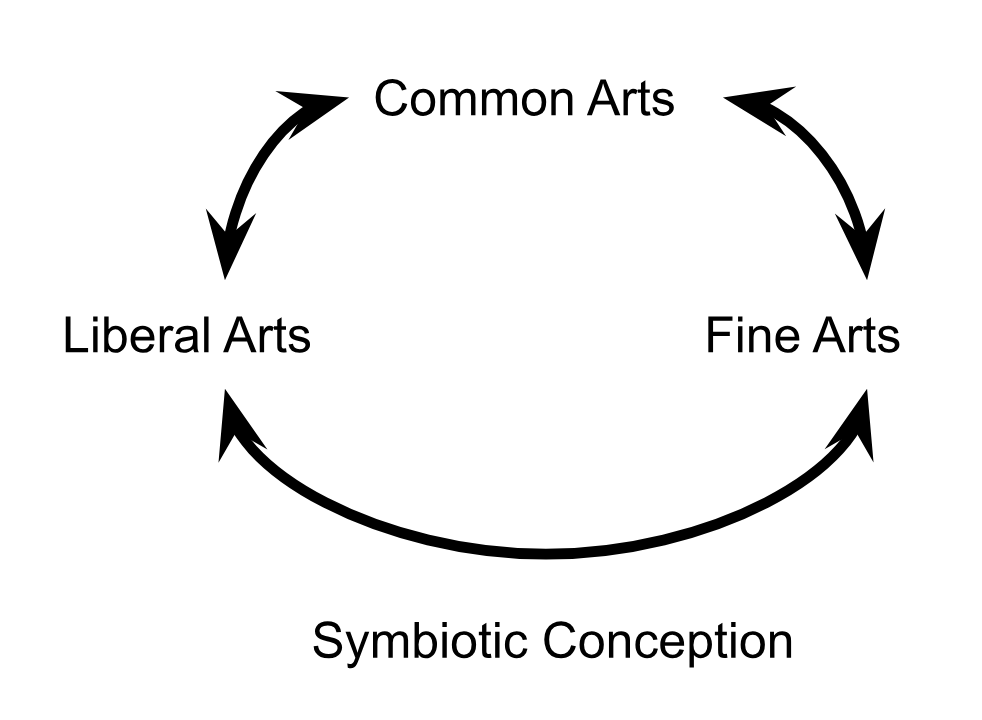
The Liberal Arts, the Fine Arts and the Common Arts exist together in a symbiotic relationship. The Common Arts provide a base level of knowledge and skill that make human flourishing possible. This human development is, itself, a necessary condition for the study of the Liberal Arts. But as one engages in the Liberal Arts, they gain insight, knowledge, wisdom, and skill that can enhance the practice of the Common Arts and/or the Fine Arts. On the one hand, this could mean learning new agricultural techniques to increase crop yield. On the other, it could translate into learning a new sculpting technique, making one a more skilled artist. So, the Common, Liberal, and Fine Arts complement and contribute to one another. All three work together to support the individual's growth and development.
As such, we feel that cutting out or ignoring any one of these three would be a disservice to our students. It’s not to say a quality education can’t be achieved without one of them, but that an education simply isn’t all that it can be without all three working together. Here at Redeemer, we love that we can offer students an education that incorporates the Common, Liberal, and Fine Arts, and shows the truth, goodness, and beauty in each one.
For more on the specifics of what that looks like at Redeemer, join us for our next post.
________________________
For more insight into the Common Arts, I’d love to point you to the following resources: Shopclass as Soulcraft (see the article that sparked the book) and Common Arts Education. I’d also like to make you aware of The College of St. Joseph the Worker, a Christian trade school.