
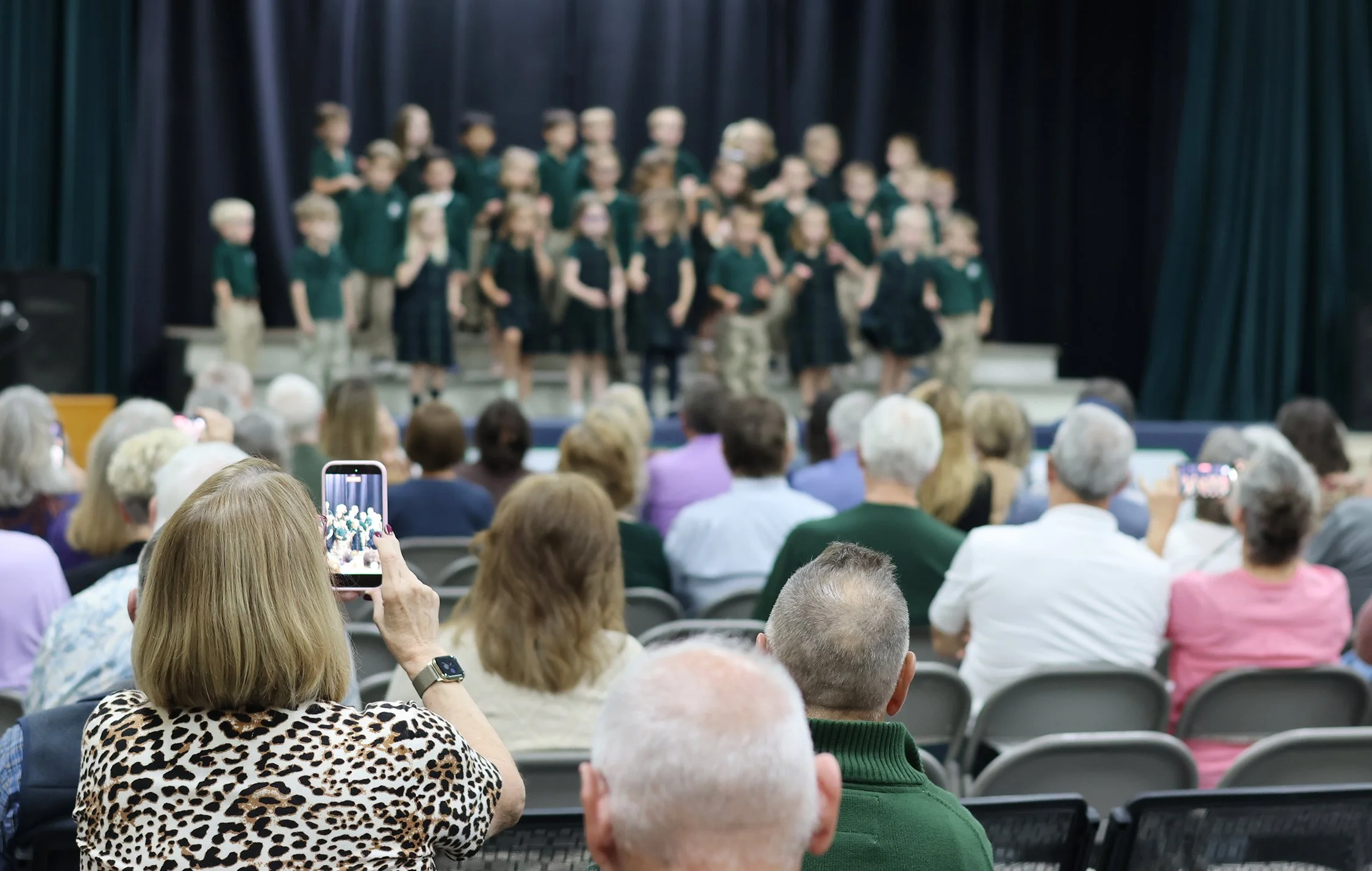
Each fall, Redeemer Classical School welcomes the grandparents of our PreK through 5th graders to campus for two mornings of recitations, classroom visits, and fellowship. This year we had the pleasure of hosting more than 350 guests on campus. We have an incredible school community that extends well beyond the people we normally see at Redeemer. Grandparents and family friends play a vital role in the lives of our students, and we loving sharing a glimpse of the life of our school with them.
Whenever our community gathers together, Mr. Hoch capitalizes on those opportunities to share a little bit more about classical Christian education. His remarks are included below.
What does it mean to know something? Does it mean that we can recite facts about it? That we can describe it? That we can identify it by sight? Does it mean that we can argue for or against it? In his book, Poetic Knowledge, James S. Taylor argues that there are essentially two types of knowledge: scientific and poetic. Scientific knowledge refers to the rational, analytical form of knowledge. Poetic knowledge is the intuitive, sensory, and emotional. Scientific knowledge treats the knowable object as something to be analyzed. Poetic knowledge treats it as something to be experienced.
Allow me to offer an example that highlights each. About a year-and-a-half ago, I visited Zion National Park with my family, and it was incredible. I’d love to go back. Scientific knowledge of Zion NP might sound like this:
Zion National Park. Southwestern Utah. Area, about 229 square miles. Elevation, 3,666 to 8,726 feet. Chief formation, Navajo Sandstone: wind-blown dunes of the Early Jurassic, roughly 190 million years old, cemented by calcite and stained by iron oxide. Principal canyon, about fifteen miles long and up to half a mile deep, cut by the North Fork of the Virgin River. Named Mukuntuweap National Monument, 1909. Made a national park, 1919.
Poetic knowledge of Zion might sound like this:
You do not look at Zion so much as stand inside it. The walls rise until your neck aches and the sky narrows to a blue ribbon overhead. In the morning the stone glows rose and cream, as if lit from within. By evening it burns red, then fades to violet. The river is small and cold and patient, and it has been at its work longer than anyone can imagine. You walk the canyon floor feeling very young and very small, and somehow glad of it. You leave without being able to say what it was, only that you will never forget it.
Which is more accurate? Which best describes what it means to know Zion NP?
Both are accurate. Both are truthful — this isn’t a way of supporting claims that “you have your truth and I have mine.” Rather, one depicts knowing about Zion and the other depicts knowing Zion. One is rooted in analysis. The other in experience. We need both forms of knowledge. But the poetic is simultaneously deeper and higher. Poetic knowledge — PROPERLY UNDERSTOOD — is rooted in a love for the thing that is known and, therefore, is closer to the reality.
It is this love for the knowable object that distinguishes poetic knowledge from subjectivism — or the claim that truth is unique for each person. In the modern era, science was king. Only that which could be explained scientifically was considered true. Poetic knowledge was dismissed as inaccurate or untrue. In the postmodern world, feelings are considered the highest arbiter of truth. In this world, poetic knowledge is conflated with emotions, sentimentality, or a disdain for objective reality. Both are distortions of the truth.
Poetic knowledge is not contrary to science, nor is it subjective. Rather, poetic knowledge asserts that to truly know something we must love and appreciate it. Poetic knowledge recognizes that we are not brains on a stick. We are body, soul, and mind. Therefore, knowing something fully — if not exhaustively — is to know it with your body, soul, and mind. Poetic knowledge agrees with the biblical notion that ultimate truth, the really real, is spiritual, not physical, for God is an infinite and eternal spirit (WSC Q4).
Classical Christian education ultimately aims at poetic knowledge. Not to the disdain of scientific knowledge, but as a crucial complement to it. We do not want our students merely to know about history, but to love it. We don’t want them to merely know scientific fact, but to stand in awe of discovery. We do not want our students to merely know about God, but to love him with their whole beings.
At Redeemer, students get their fair share of scientific knowledge, as Taylor defines it. They memorize a lot of information. They study facts about the creation and the creator. They are taught to think logically and use reason to formulate a cogent, persuasive argument. But we hope they learn something more than that, too. We hope they learn to enjoy the beauty of the world around them, to stand in awe of both the creation’s grand scale and its infinitesimal order. We hope they love God, not as an abstract idea, but as the Creator-Savior-King of the universe who, out of love for his children, sacrificed his Son. We don’t want a student examining a leaf under a microscope to stop at merely understanding the chemical reactions that lead to it changing colors in the fall. We want them to enjoy its beauty and worship the God who makes it so.
The emphasis on poetic knowledge is one of the core features of a classical Christian education. Many schools can and do teach facts. It is classical Christian education that seeks to nurture students’ love for the truth, so that they may, ultimately, love and enjoy the creator and sustainer of all truth more deeply, more passionately, and more purely.